

The Future of Human Resources: Who Will Care for the Human at Work?
Introduction: The Paradox of Human-Centered Capitalism
Over the last two decades, HR has been progressively reframed from an administrative function into a strategic cornerstone of organizational sustainability. Yet, the paradox persists: while organizations increasingly emphasize human-centricity, individuals often feel dehumanized by algorithmic systems, hyper-automation, and quantification of their performance. The core question of the next 15 years is not merely how HR will adapt to technological disruption, but who — or what — will take responsibility for the human condition at work.
1. The Collapse of Traditional HR Architecture
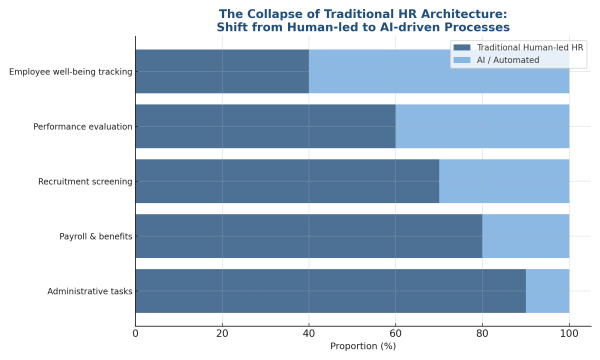
Recent studies from the World Economic Forum (2024) indicate that over 65% of HR administrative tasks are now automated. The emergence of algorithmic management systems has shifted HR from “people professionals” to “data stewards.”
-
Structural implication: HR no longer controls people decisions alone; AI-driven platforms intermediate recruitment, evaluation, and even well-being.
-
Theoretical perspective: In socio-technical systems theory, this marks a shift from “personnel administration” to cybernetic governance of labor.
-
Critical observation: HR professionals risk being displaced not by AI itself, but by the quantification logic that redefines humans as datasets.
2. Neuro-ergonomics and the Cognitive Worker
The next phase of HR evolution involves neuro-ergonomics — the intersection of neuroscience, psychology, and ergonomics — applied to organizational design.
-
Evidence: A 2025 McKinsey Global Institute survey found that 41% of firms in advanced economies are piloting neurocognitive monitoring (EEG headbands, biometric stress sensors).
-
Implication: The “employee experience” is becoming a quantifiable neural state, feeding into dashboards for predictive HR analytics.
-
Ethical paradox: Care for the human becomes conflated with control of the human, raising questions of autonomy and surveillance.
3. The Reframing of “Care” in Organizational Contexts
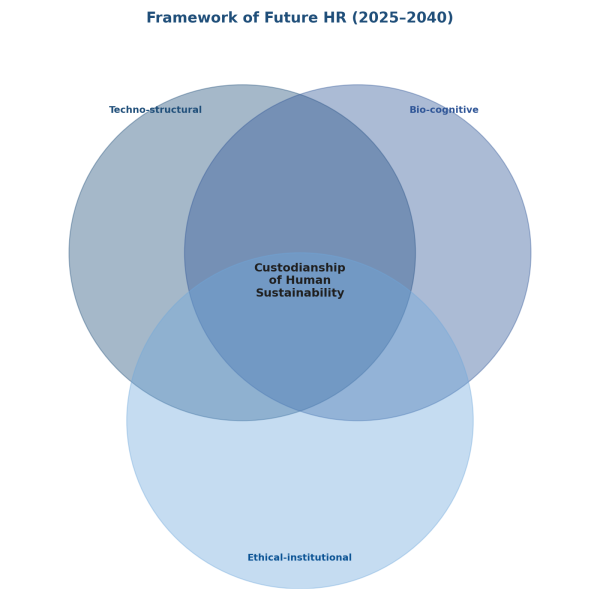
In traditional HRM, care was paternalistic: benefits, safety, compliance. In post-2025 HR, care becomes systemic and multi-layered:
-
Physical sustainability – ensuring long-term well-being beyond productivity (sleep, recovery cycles, ergonomic design).
-
Cognitive sustainability – managing attention capital, neuroplasticity, and decision fatigue.
-
Moral sustainability – balancing organizational purpose with individual meaning.
This triadic model transforms HR from a transactional function into a custodian of human sustainability.
4. Human vs. Post-Human HR
-
Scenario 1: Human-Centered HR – humans remain at the core, with AI as augmentation.
-
Scenario 2: Post-Human HR – AI agents assume most HR functions, with humans only as exception handlers.
-
Scenario 3: Hybrid Custodianship – shared governance where “care” is distributed between humans, machines, and legal-institutional frameworks.
Philosophically, the critical question is: Can machines care? Or is care inherently human, and thus HR must evolve into a “meta-human” institution safeguarding the human essence against reductionism?
5. The Future of HR Value Creation (2025–2040)
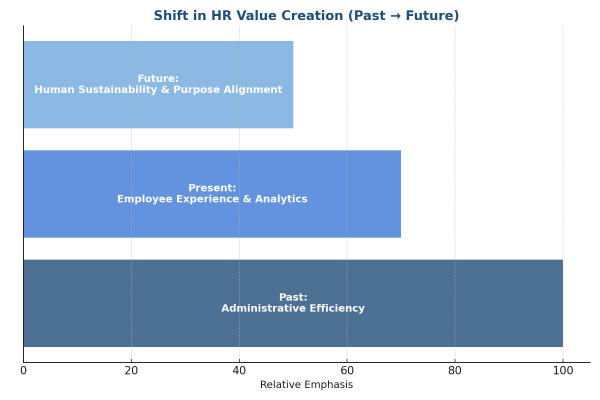
Traditional HR value creation was measured in efficiency (lower turnover, faster hiring). Future HR will be measured in human sustainability metrics:
-
Attention span resilience (minutes of undistracted focus).
-
Cognitive recovery half-life (time to return to baseline after stress).
-
Purpose alignment index (degree of meaning derived from work).
-
Neural inclusivity metrics (cognitive diversity integration).
This reframes the HR function not as “managing resources” but as managing humanity in resource-constrained organizations.
6. Conclusion: Who Will Care for the Human?
The future of HR is paradoxical: technology enables unprecedented levels of personalization, but risks eroding the very autonomy it aims to enhance. Ultimately, the responsibility for care cannot be outsourced entirely to algorithms. It requires a new hybrid institution — where HR professionals, ethicists, AI systems, and policymakers co-create a governance model that treats human beings not merely as inputs into a system, but as ends in themselves.
The central insight: Future HR will be less about “managing” humans, and more about protecting humanity at work.