
Management in 2023: From Control Systems to Complexity Governance
Introduction
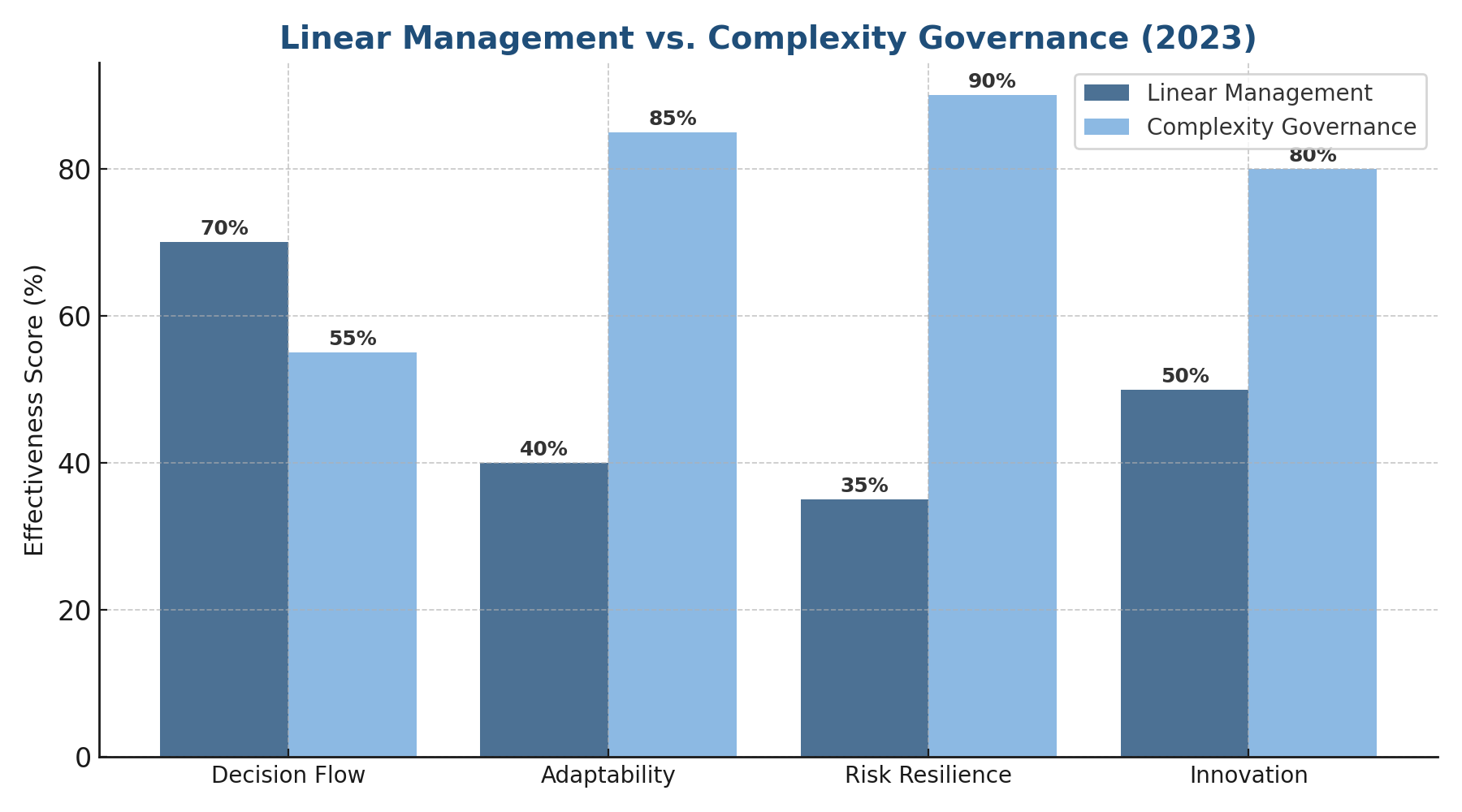
2023 was the year when management formally crossed the boundary from linear administration into the realm of complexity governance. Traditional models — hierarchy, authority, top-down planning — proved inadequate in the face of distributed hybrid teams, AI augmentation, and non-linear global shocks. For professionals in organizational design, this required a reframing: managers were no longer controllers of processes but architects of adaptive systems.
1. The Collapse of Linear Managerial Models
-
Taylorist assumptions — predictability, standardization, incremental efficiency — reached their limits.
-
Organizations discovered systemic risk asymmetry: small perturbations (talent attrition, supply chain delays) cascaded into global disruption.
-
McKinsey’s 2023 Complexity Report highlighted that firms relying on rigid management models had 24% higher volatility in KPIs compared to adaptive enterprises.
2. From Management to Meta-Management
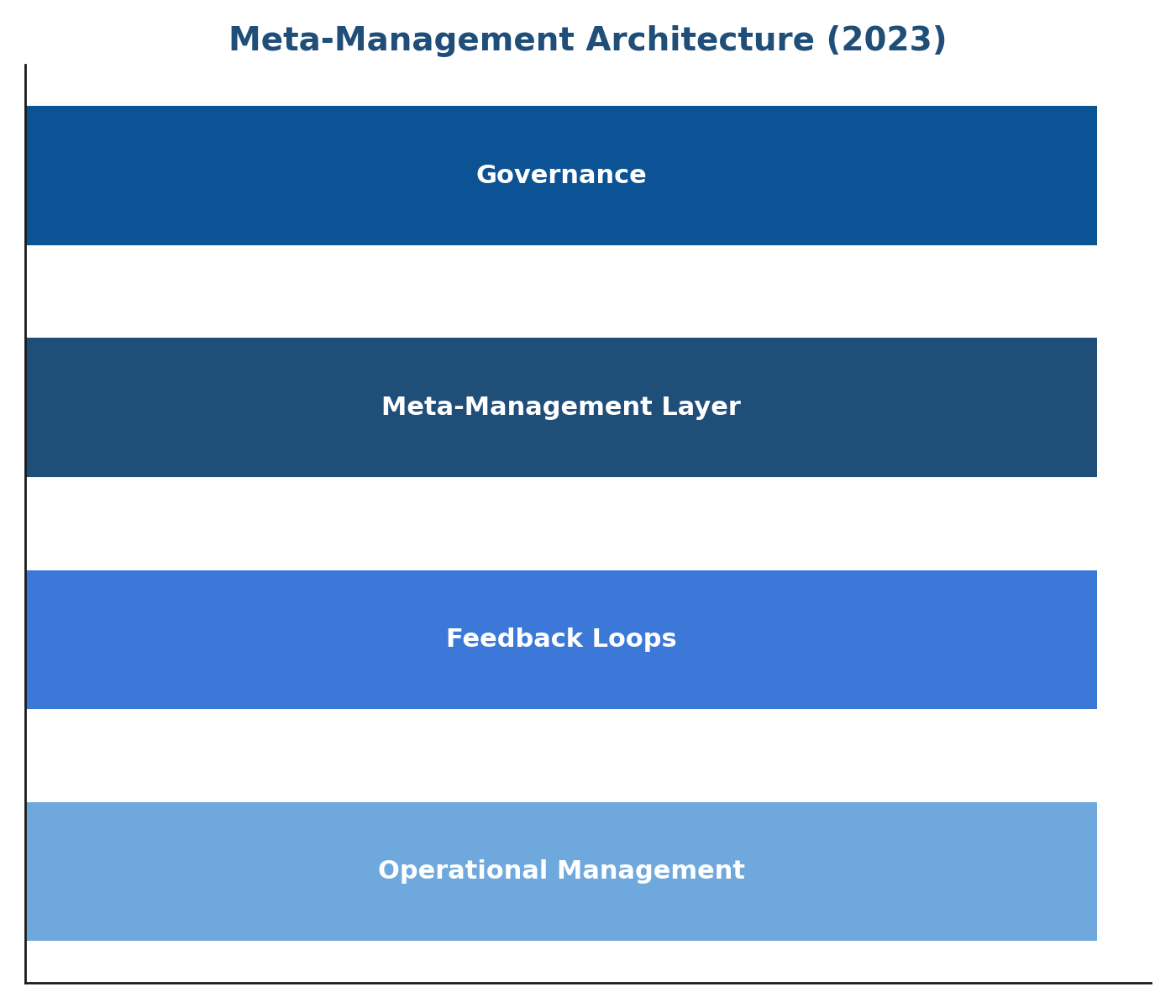
The shift in 2023 was from managing tasks to managing systems of management.
-
Meta-management layers: governance over how decisions are distributed, escalated, and audited.
-
Feedback architecture: embedding feedback loops across every node (from frontline to board).
-
Recursive control: managers monitoring not only outcomes, but the integrity of the decision architecture itself.
This was the year when management became reflexive — it managed its own mechanisms.
3. Complexity Theory Applied to Organizations
2023 saw widespread adoption of complexity theory in management practice:
-
Non-linear dynamics: performance curves became unpredictable; minor structural changes produced disproportionate effects.
-
Emergence: teams generated solutions not forecastable from top-down instructions.
-
Attractors: informal norms and digital platforms acted as “strange attractors,” shaping organizational behavior more strongly than formal policies.
Managers were forced to learn systems literacy, treating enterprises as adaptive ecosystems rather than mechanical machines.
4. Algorithmic Augmentation and Managerial AI
Management in 2023 integrated algorithmic augmentation:
-
Predictive dashboards for resource allocation.
-
Agent-based simulations modeling organizational responses to shocks.
-
AI-mediated decision routing, where algorithms pre-sorted issues before human escalation.
Yet, this raised the alignment paradox: managers became dependent on opaque models, introducing risks of delegated accountability.
5. Leadership as Governance of Trust
In complexity governance, leadership was redefined:
-
Trust-as-infrastructure: measured through organizational network analysis.
-
Cultural entropy: tracked as a quantifiable KPI of cohesion.
-
Systemic legitimacy: leaders were evaluated not by charisma, but by their ability to maintain stability within emergent complexity.
6. Lessons from 2023
-
Management ceased to be a practice of control and became a practice of designing adaptive governance.
-
Resilience depended on recursive systems of feedback, not linear escalation chains.
-
AI in management amplified decision-making power but also deepened dependency on black-box logic.
-
Complexity theory shifted managers from engineers of efficiency to curators of emergence.
Conclusion
2023 marked the intellectual inflection point: management could no longer be explained as administration. It became a cybernetic discipline, requiring literacy in systems theory, algorithmic augmentation, and organizational complexity.
The central insight of 2023: to manage is no longer to control, but to govern the conditions under which adaptive complexity emerges.