
Hybrid Work and Organizational Resilience in 2023: Lessons Learned
Introduction
2023 became the year when organizations finally stopped treating hybrid work as a temporary emergency model and began to redesign it as a structural element of corporate strategy. Yet, resilience — the capacity to sustain operations and culture across fragmented environments — emerged as the ultimate differentiator between companies that thrived and those that stagnated.
1. The Hybrid Work Paradox
-
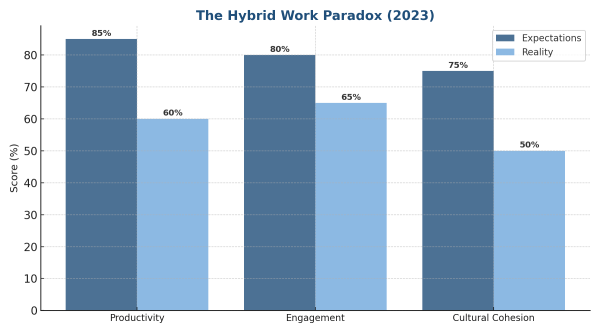
On the surface, hybrid work promised flexibility and higher engagement.
-
In practice, companies without robust systems suffered from coordination entropy: unclear role expectations, uneven productivity, and loss of cultural cohesion.
-
McKinsey’s 2023 Global Survey reported that 61% of organizations struggled with synchronization of hybrid teams, while only *27% had formal frameworks for distributed collaboration.
2. Resilience as a Competitive Advantage
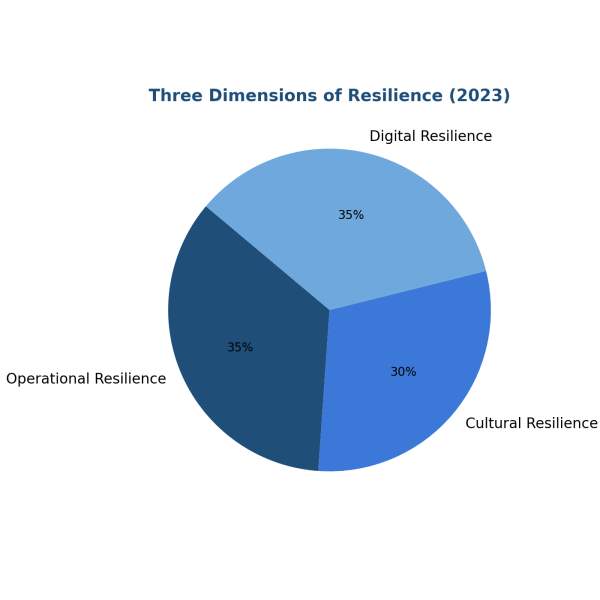
Resilience in 2023 was no longer measured only by financial health. Leading firms adopted a multi-dimensional model:
-
Operational resilience – ability to sustain workflows under shocks (e.g., supply chain disruptions).
-
Cultural resilience – maintaining trust and belonging across hybrid environments.
-
Digital resilience – ensuring continuity of data and systems through secure hybrid infrastructures.
This systemic approach echoed cybernetics: resilience was treated as feedback and adaptation capacity.
3. Technology and the First AI Pilots in HR
2023 also marked the first real experiments with AI in HR operations:
-
AI-driven scheduling tools reduced meeting overload by 22% in some global firms.
-
Natural Language Processing tools were tested for sentiment analysis of employee surveys, uncovering cultural weak points invisible to traditional metrics.
-
Risk: Bias and lack of explainability limited adoption, with only 18% of enterprises moving beyond pilot projects.
4. Leadership in the Hybrid Era
The hybrid context demanded a shift in leadership capabilities:
-
From presence-based authority (physical office, visibility) → to outcome-based trust (deliverables, accountability).
-
Leaders in resilient firms demonstrated high systems literacy: the ability to understand teams as distributed networks, not just collections of individuals.
-
Harvard Business Review data (2023) showed that companies with leaders trained in distributed systems thinking had 12% higher engagement scores in hybrid teams.
5. Lessons Learned (2023)
-
Hybrid work is sustainable only when supported by explicit governance frameworks.
-
Resilience is multi-layered: operational, cultural, and digital must reinforce each other.
-
AI was a useful experiment, but in 2023 it remained a complementary tool, not yet a strategic layer.
-
Leadership training had to expand beyond soft skills into systems design literacy.
Conclusion
2023 was the year hybrid work matured from improvisation to structured reality. Organizations that invested in resilience — not only operational, but cultural and digital — entered 2024 with an advantage. Those who treated hybrid as “business as usual” without systemic redesign faced growing entropy and disengagement.