
Introduction
2024 marked a decisive shift in how organizations approached leadership and culture. The turbulence of post-pandemic recovery, rapid integration of AI, and global geopolitical uncertainty forced executives to reconsider culture not as a set of values written on office walls, but as an adaptive operating system of the enterprise. Leadership was no longer about vision statements, but about orchestrating dynamic trust, resilience, and distributed autonomy.
1. The Decline of “Heroic Leadership”
-
For decades, corporations celebrated charismatic leaders.
-
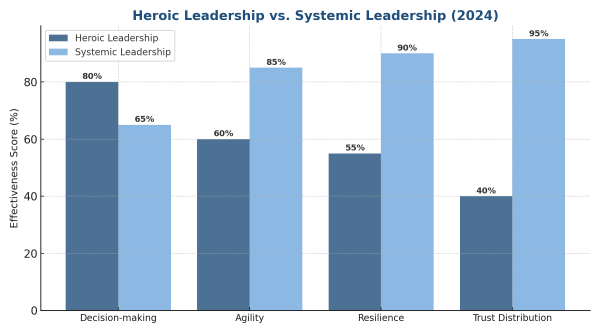
In 2024, research by Gartner showed that organizations relying on single-person leadership narratives underperformed by 11% in agility metrics compared to companies with distributed decision-making models.
-
The shift was towards systems leadership: leadership embedded at multiple nodes of the organization rather than centralized at the top.
2. Culture as Infrastructure
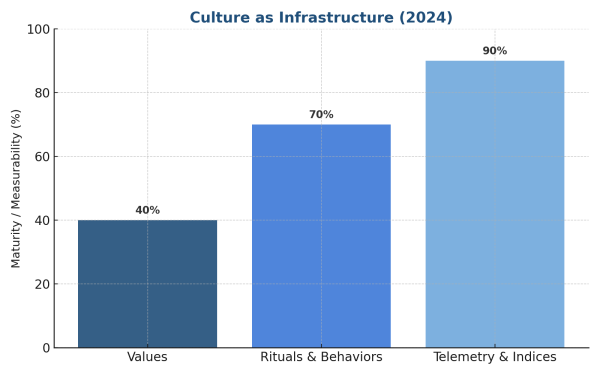
In 2024, progressive firms began treating culture less as beliefs and more as infrastructure.
-
Cultural APIs: Translating norms into codified rituals and digital behaviors.
-
Trust telemetry: Using organizational network analysis to measure trust flows across teams.
-
Resilience indices: Culture became quantifiable via turnover resilience, adaptation to policy changes, and feedback loops.
Example: A global tech firm used digital cultural twins — simulations of corporate values — to forecast resistance levels to new AI deployment policies.
3. The Role of AI in Leadership Practices
AI became a mirror for leadership in 2024:
-
Natural Language Processing tracked leadership communication patterns, highlighting tone, inclusivity, and bias.
-
AI dashboards provided leaders with real-time culture health scores, predicting when cultural misalignment would trigger attrition.
-
Leadership training integrated cognitive simulations where executives faced AI-generated dilemmas to stress-test their ethical reflexes.
4. Case Implications for Multinational Enterprises
-
Biotech sector: leaders were measured by their ability to align R&D teams across divergent compliance regimes.
-
Finance: cultural cohesion across virtual teams became critical for risk governance.
-
Domestic services: leadership authenticity was key to employer branding and talent retention.
5. Strategic Recommendations (2024)
-
Shift from heroic to systemic leadership — empower middle management as cultural amplifiers.
-
Instrumentalize culture — treat values as infrastructure, not posters.
-
Deploy cultural telemetry — use AI to measure trust, cohesion, and resilience.
-
Reframe leadership training — emphasize systems thinking and ethical reflexes under uncertainty.
Conclusion
2024 was the year corporate culture and leadership transformed from narrative-driven to data-informed and adaptive. Organizations realized that culture is not what you say, but how your system behaves under stress. Leaders in 2024 were judged less by their charisma and more by their ability to orchestrate trust across distributed, AI-augmented enterprises.