
Rethinking Workforce Strategy in 2025: From Human Capital to Human Systems
Introduction: Beyond “Human Capital”
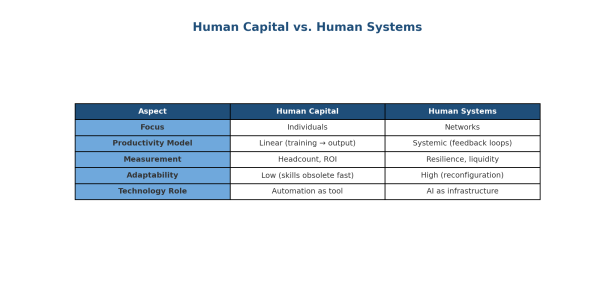
For decades, the term human capital dominated HR and management discourse, framing employees as assets to be optimized. In 2025, this perspective is increasingly insufficient. In a world shaped by AI agents, distributed organizations, and volatile markets, the real competitive advantage lies not in isolated human skills, but in human systems — the dynamic interplay between people, technologies, and governance structures.
1. Why Human Capital Theory Falls Short
-
Linear models of productivity (training → output) no longer explain performance in multi-agent, AI-augmented environments.
-
Skill depreciation cycles have accelerated: what once took 5 years to obsolete now takes 18 months.
-
Talent liquidity matters more than headcount — the ability to redeploy, reconfigure, and adapt skills across contexts.
2. Human Systems as the New Paradigm
A human system is defined not just by individuals, but by:
-
Feedback loops: data-informed decision making across teams.
-
Interoperability: cross-functional and cross-geographic collaboration.
-
Resilience: capacity to absorb shocks without breaking workflow integrity.
This systemic approach echoes cybernetics: people are not inputs into a machine, but nodes in a self-regulating network.
3. The Role of AI in Human Systems
AI acts less as a replacement and more as a cognitive infrastructure:
-
Augmenting decision cycles (predictive hiring, workload balancing).
-
Detecting competency erosion before it becomes visible.
-
Creating ontologies that standardize skills and knowledge across markets.
Thus, AI is not just a tool — it is part of the system’s nervous system.
4. Case Implications for Global Organizations
-
R&D-driven sectors (biotech, pharmaceuticals) require ontology-based HR to reconcile regulatory and knowledge-intensive environments.
-
Financial services leverage AI-augmented compliance HR to reduce audit risk.
-
Domestic staffing & services benefit from liquidity models, where rapid redeployment is as critical as recruitment.
5. Strategic Recommendations
-
Adopt systems thinking in HR — shift KPIs from headcount metrics to network resilience metrics.
-
Invest in ontology-driven platforms (such as Bio-HRding) for semantic consistency across sites.
-
Embed AI agents into HR operations not only for automation, but for anticipatory governance.
-
Train leaders in systems literacy — the ability to interpret organizations as adaptive ecosystems.
Conclusion
The future of HR in 2025 is no longer about managing people as capital. It is about designing human systems that are adaptive, intelligent, and resilient. Businesses that fail to make this shift will optimize individuals but lose the system; those that succeed will build organizations capable of evolving as fast as the environments in which they operate.