
Dubai Labor Market: Expert Analysis by CEO Alexandra
Introduction
Dubai remains one of the most dynamic labor markets in the world. The demand for skilled professionals is shaped not only by economic growth but also by the government’s strategic vision to position the emirate as a global business hub.
1. Demographic Context
Data: Dubai’s population exceeds 3.6 million, with around 87% being expatriates. The workforce is concentrated in the 25–44 age group, with men making up nearly 70%.
Expert Commentary:
This demographic profile highlights Dubai’s strong reliance on foreign labor. While it ensures flexibility and responsiveness to market needs, it also poses risks for long-term social balance.
Recommendation: Employers must focus not only on recruitment but also on retention strategies, as competition for talent is global.
2. Government Initiatives and Overall Indicators
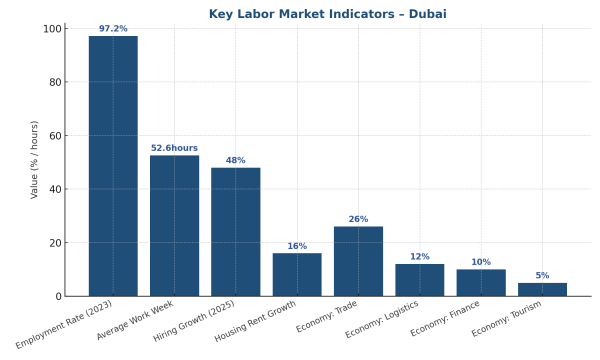
Data: Employment in the UAE exceeds 96%, with an average work week of 52–53 hours.
Expert Commentary:
High employment rates reflect resilience, but long working hours signal risks of burnout and high turnover.
Recommendation: HR strategies should integrate flexible schedules, wellness initiatives, and career development programs to sustain long-term productivity.
3. Competitiveness and Global Rankings
Data: The UAE ranks 1st globally in several IMD competitiveness indicators, including low termination costs, labor market growth, and bureaucratic efficiency.
Expert Commentary:
This makes Dubai attractive for investors, yet it creates challenges for employees, as protections are weaker compared to Europe.
Recommendation: Professionals must carefully review employment contracts, while employers should enhance transparency to retain top talent.
4. Work Culture and Workload
Data: The UAE ranks among the top countries for longest work weeks (approx. 51 hours).
Expert Commentary:
This reflects high business intensity but may reduce long-term employee well-being.
Recommendation: Work-life balance policies are essential, or rising salaries will not offset the pressure, leading talent to leave for more balanced jurisdictions.
5. Employment Prospects
Data: Hiring growth forecast for 2025 is +48%, with strong demand in transport, logistics, energy, and consumer sectors.
Expert Commentary:
These industries will be growth drivers. For professionals, this creates opportunities; for employers, it increases the need to build strong employer branding.
Recommendation: Companies should invest in partnerships with universities and vocational institutions to ensure a pipeline of skilled labor.
6. Cost of Living and Living Conditions
Data: Housing rents rose 16% in one year, while wages stagnated in several sectors. Some unskilled workers earn just $300 per month and face poor housing conditions.
Expert Commentary:
The rising cost of living may limit Dubai’s attractiveness for mid-level professionals. Vulnerable migrant groups may also become a reputational risk for employers.
Recommendation: Employers should offer housing allowances, healthcare, and education benefits to remain competitive in retaining staff.
7. Economic Structure and Industrial Clusters
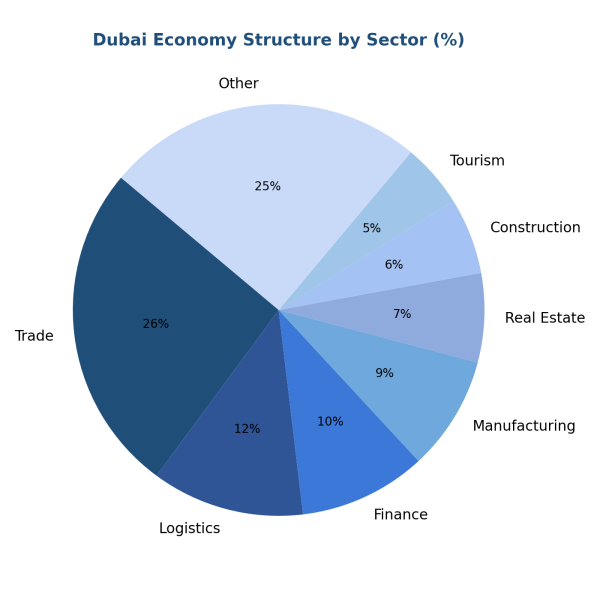
Data: JAFZA accounts for 21% of Dubai’s GDP and employs over 140,000 people. The economy is diversified: trade (26%), logistics (12%), finance (10%), tourism (5%).
Expert Commentary:
This diversified model ensures stability beyond oil revenues. It also creates opportunities in IT, green energy, and fintech.
Recommendation: Employers should anticipate global trends—digitalization, ESG, automation—and attract talent with modern skill sets.
Final Expert Conclusions
-
Dubai’s labor market is growing, but talent retention is the critical challenge.
-
Competition for skilled workers requires companies to strengthen employer branding.
-
High living costs and workloads are barriers that must be addressed.
-
Business benefits include a supportive government framework and competitive regulations.
-
Long-term strategy lies in skills development, employee protection, and adapting corporate culture to global standards.